
InfoLibrarian™ Enterprise Metadata and Knowledge Graph Platform
Enterprise metadata into a knowledge graph.
Enterprise metadata feeds a governed knowledge graph so people and agents get connected context. What began as the Metadata Appliance is this platform — InfoLibrarian™ Studio AI and the Knowledge Graph Engine, commercial IP by license.
AI-native enterprise metadata: the platform does the heavy lifting so people and agents share one governed graph — without a standing army of stewards or endless integration projects.
Powered by the Knowledge Graph Engine. Runs in your environment. Air-gap capable. Bring your own models.
Updated September 26, 2026
Platform IP = Studio AI + Knowledge Graph Engine. License only. Runs in your (or your customer's) environment. Air-gap capable. BYO models. VARs, resellers, and consulting orgs — partner keeps the customer.
Key takeaways
- Enterprise metadata → a governed knowledge graph you license — Studio AI + Knowledge Graph Engine.
- Air-gap and BYO models in your environment — your metadata, content, and graph stay under your control.
- Heritage Metadata Appliance (2005) → AI-era Engine — classic IP is proof; Platform IP is the current offer.
Governed metadata→KG you own — not another SaaS catalog seat
Licensee or VAR deployments can host multiple end-customer tenants in your environment — not InfoLibrarian SaaS.
FAQ
Who is this for?
VARs, resellers, SIs, and OEMs who want licensed Platform IP and keep the customer.
What is licensed?
Bucket A only: Studio AI + Knowledge Graph Engine.
Is this SaaS?
No. It runs in your (or your customer's) environment.
Partners as delivery accelerator?
Partners can use Platform IP as a delivery accelerator inside modernization or metadata-debt SOWs — partner keeps the customer.
Download Platform Brief → All 2026 briefs → Inside the engine →
InfoLibrarian™ Studio AI
Build your first governed knowledge graph.
Ask AI on your ontology and enterprise metadata. Wire your agents to the same governed graph — impact, lineage, and answers with provenance.
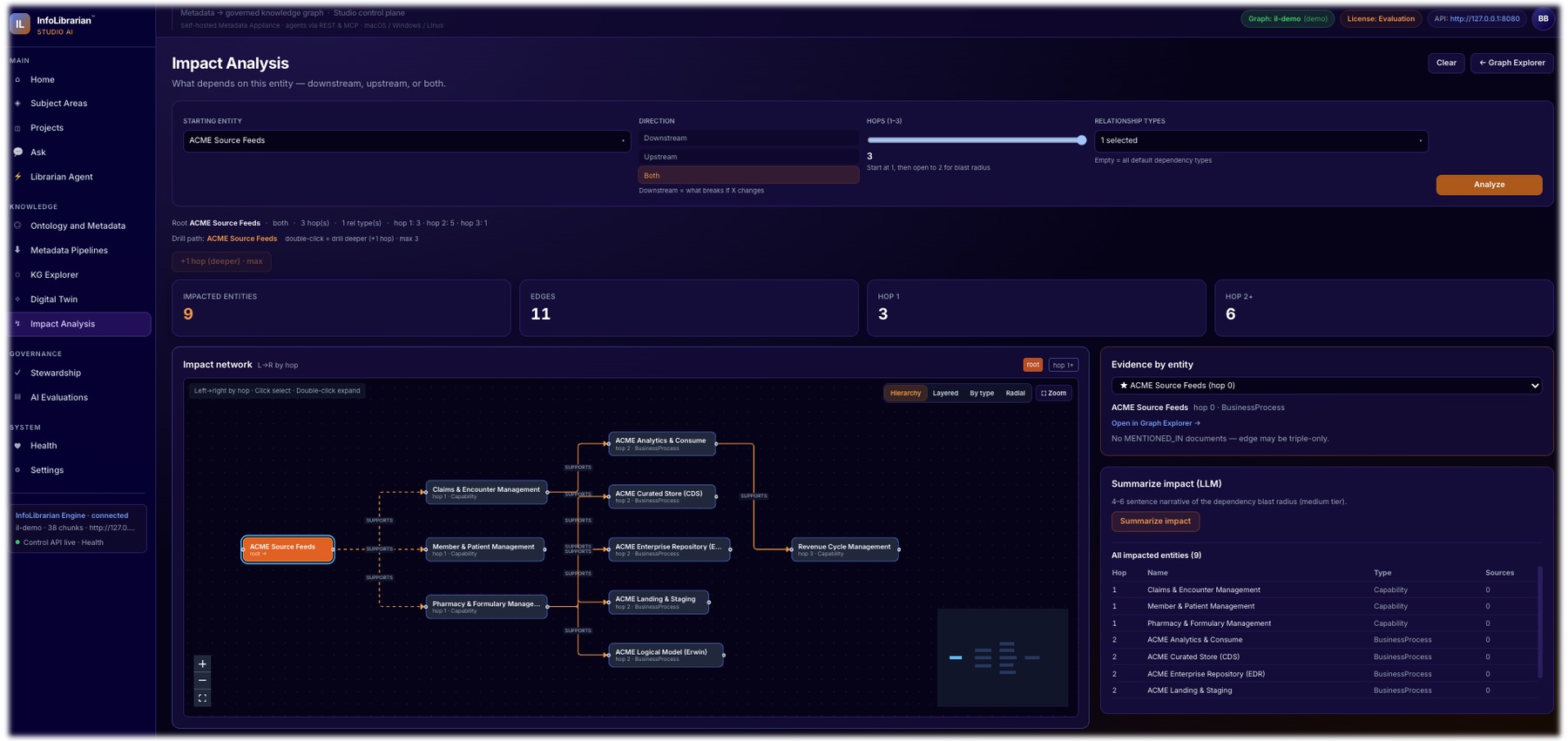
2026 · Studio AI · Platform briefs
Briefs for partners and license conversations
Enterprise metadata heritage became an AI-native knowledge graph platform. Low HITL. Weeks, not years. Agents consume the same governed graph. Air-gap capable; bring your own models.
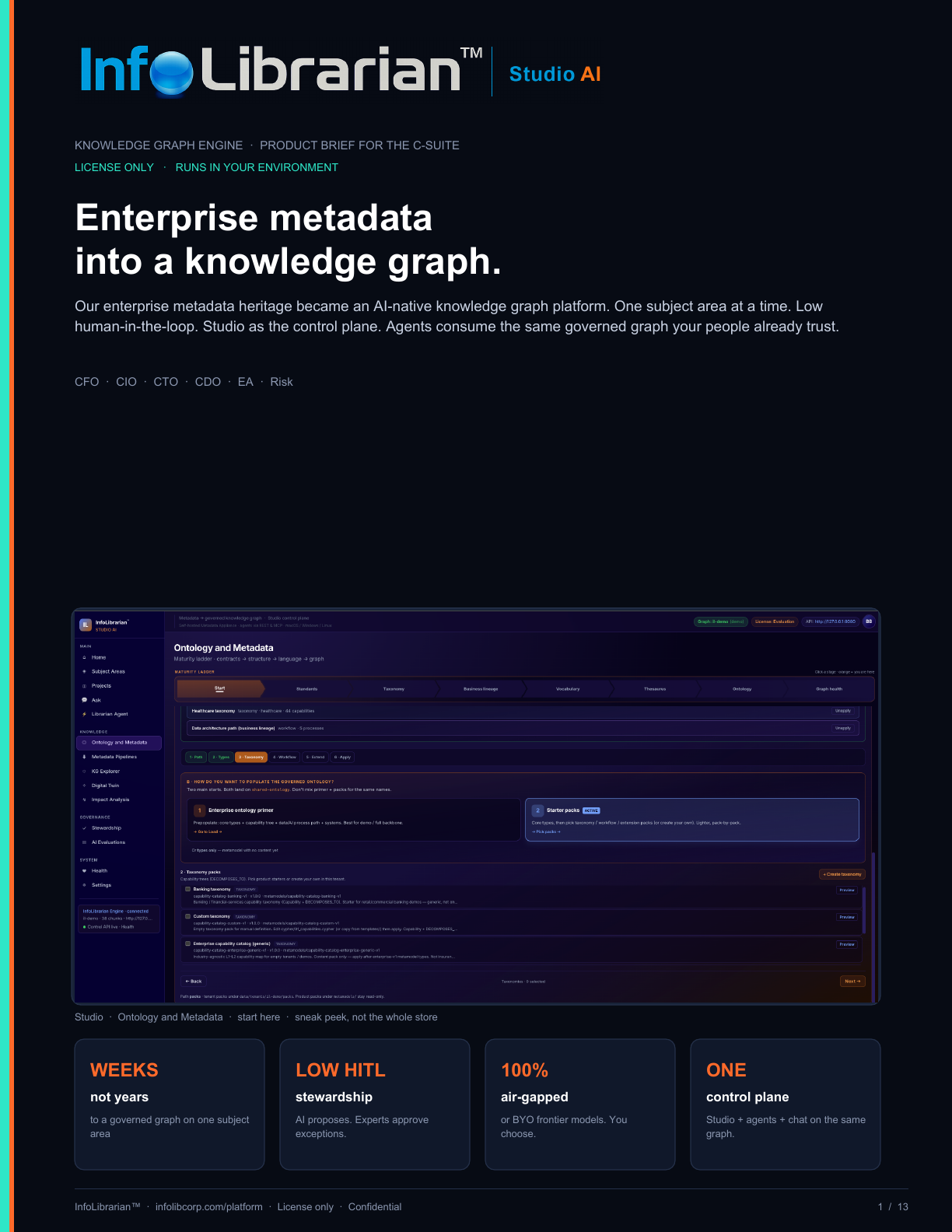
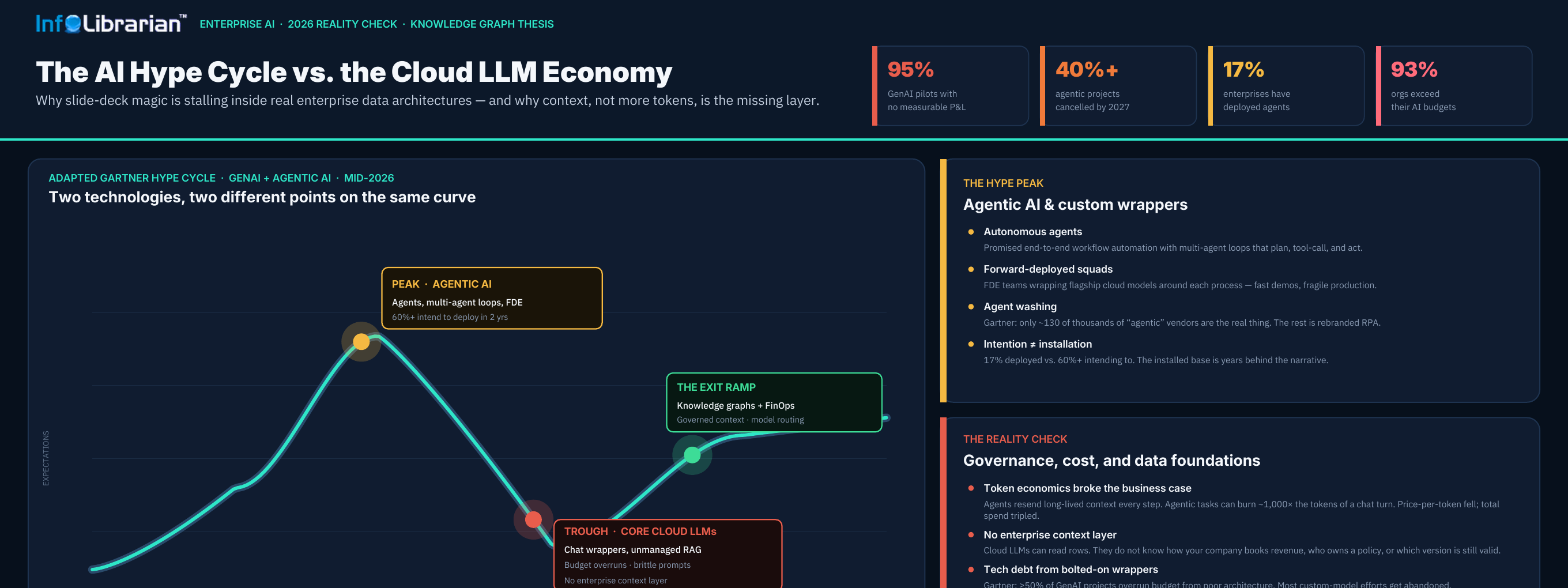
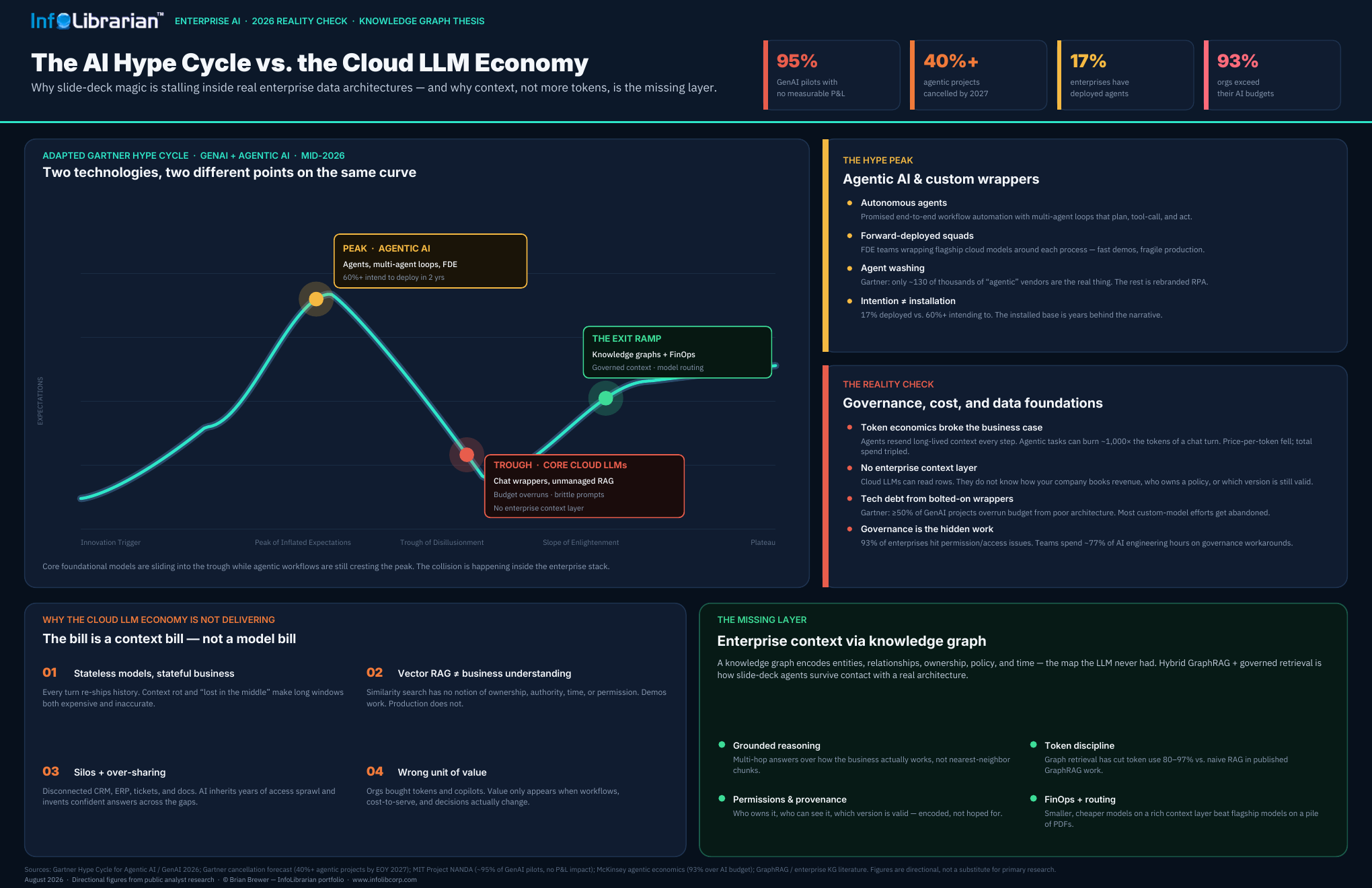
Licensing: Slack (infolibcorp) — contact for Platform IP conversations. No form required.
How it works
Capture → Connect → Activate → Trust. Detail lives in the briefs; this is the operating sequence.
What you get
Governed graph for people and agents — full detail in the Platform Brief.
Governed knowledge graph
Enterprise metadata (structured and unstructured) into connected meaning with provenance.
Studio AI + engine
InfoLibrarian™ Studio AI on the Knowledge Graph Engine — low HITL, subject-area scope, weeks not years.
Built for agents
Same governed graph for people and agents — open interfaces, measured trust, explainable paths.
Your environment
Runs where you run. BYO models. Air-gap capable for regulated estates.
One package, three sizes
Ready-to-run package (VM or container). You size the environment; the same software runs on pilot, production, and enterprise tiers.
- One subject area
- Apple Silicon or RTX 4080/5080 class
- Single user, proof of concept
- Single or few domains
- RTX 5090 class
- Small team, dedicated inference
- Enterprise, multi-domain
- A100 / H100 class
- Department scale, full parallel
Runs in your environment
Your metadata, content, and answers stay under your control — no requirement to send them to a third-party model host.
Bring your own AI models and LLMs. Anthropic, OpenAI, Hugging Face, Ollama, Azure OpenAI, private and on-prem endpoints, and other approved hosts. The platform grounds those models in your governed knowledge graph.
Air-gapped capable.
Metadata, content, graph, and inference stay inside your boundary when policy requires it.
Heritage · 2005 → 2026
Enterprise metadata heritage became an AI-native knowledge graph platform. Classic product IP is heritage. The craft continues as modernized Platform IP — engineering record · portfolio.
Platform and Knowledge Graph Engine are InfoLibrarian commercial IP, available by license. Licensing: Slack (infolibcorp) — contact. No form required.